Winter tire tread depth: how much you need for snow
By Tread AI team. Updated November 8, 2026
Plan to replace winter tires when the shallowest groove reaches about 6/32″ (4.8 mm), and don't rely on them in snow once they're near 5/32″ (4 mm). The 2/32″ (1.6 mm) legal minimum in most US states is a worn-out tire, not a winter number.
| Depth | In snow | In rain | Winter rules it still meets |
|---|---|---|---|
| 10/32″–12/32″ (7.9–9.5 mm) | New winter tire, full snow grip | Full grip | All of them |
| 8/32″ (6.4 mm) | Good | Good | All of them |
| 6/32″ (4.8 mm) | Starting to fade. Treat this winter as the last one | Good | All of them, at the limit: Colorado and Caltrans require 6/32″; Quebec advises 4.8 mm |
| 5/32″ (4.0 mm) | Reduced. Transport Canada says not to use tires near 4 mm on snow | Fair | BC (3.5 mm) and Washington (4/32″); fails Colorado and California |
| about 4½/32″ (3.5 mm) | Poor | Fair, and getting worse | BC's legal floor on posted routes, and Washington |
| 4/32″ (3.2 mm) | Too worn for snow | Replace soon: wet braking gets longer | Only Washington's traction-tire minimum; fails BC |
| 2/32″ (1.6 mm) | Worn out | Worn out | None. Only the general legal minimum in most US states |
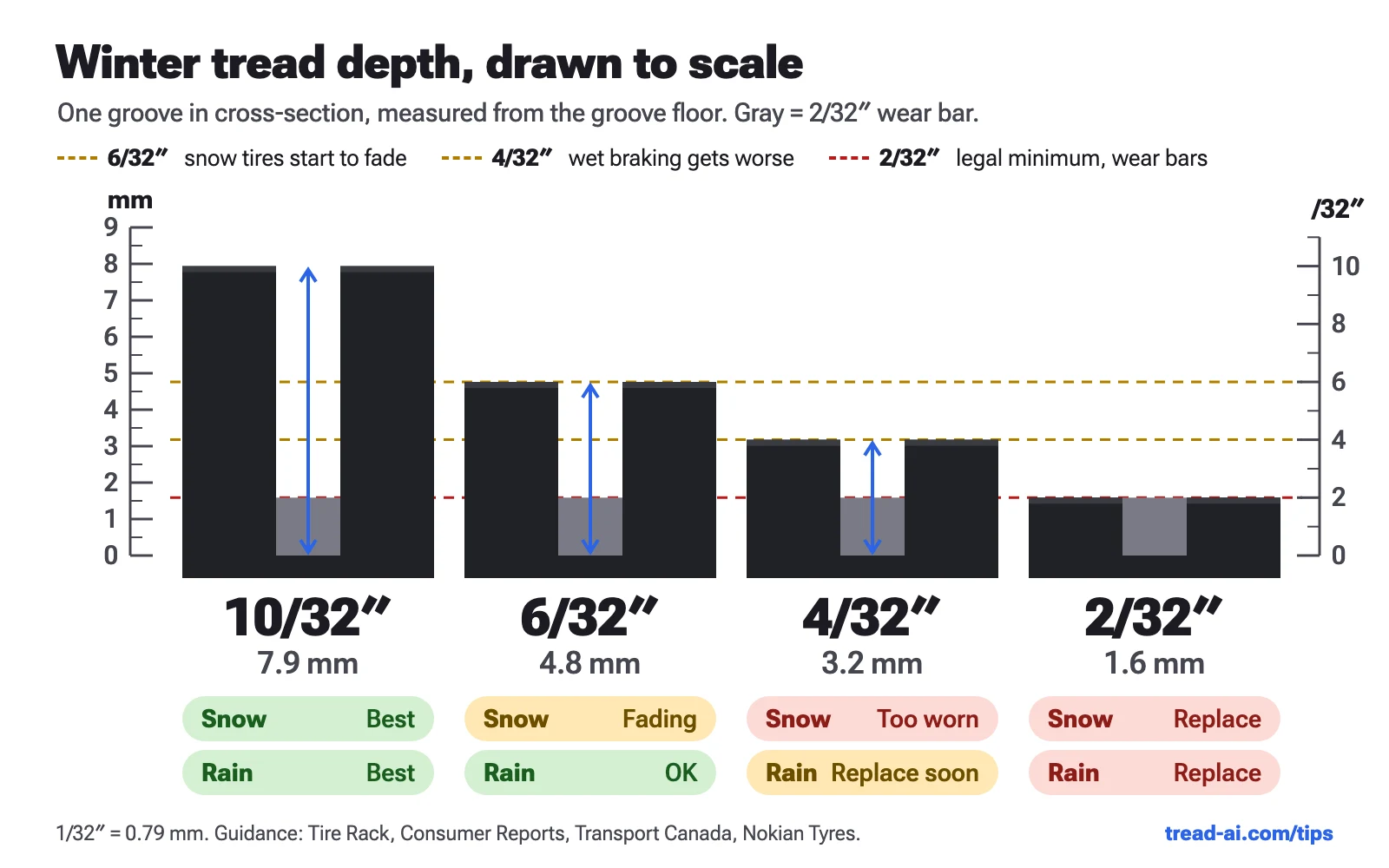
How much tread do winter tires need for snow?
About 6/32″ (4.8 mm) is the point to start planning new winter tires, and about 5/32″ (4 mm) is where you should stop counting on them in snow. Tire testers, tire makers and safety agencies land in that narrow band. Tire Rack's depth chart says a tire at 6/32″ is "beginning to lose snow and slush winter traction" and advises replacing at about 5/32″ if snow-covered roads are a concern. Nokian Tyres says not to drive on winter tires below 5/32″–6/32″. Transport Canada says not to use tires worn close to 4 mm on snow-covered roads.
Consumer Reports sets a lower floor: start shopping at 4/32″ (3.2 mm), and in snow country make sure you still have at least that much in the middle of winter. That fits with the higher numbers once you remember that tread keeps wearing all season. To still have 4/32″ in February, a tire has to start the winter with more, which is why the reading you take in the fall should clear 6/32″.
Why snow needs deeper tread than rain
In snow, the grooves do the gripping. As the tire rolls, each groove packs a bite of snow and then releases it, and the packed snow grips the snow on the road. Tire Rack explains that if the grooves are too shallow, those "bites" shrink to nibbles. Winter tires also rely on sipes, the thin slits cut across each tread block, which Continental credits with better braking and traction on snow and ice. As the blocks wear down, the sipes get shallower too.
Rain is different. Water can't be compressed, so the grooves only have to carry it away fast enough to keep the tire from hydroplaning. That is why the rain line sits lower, at 4/32″. Both effects show up in testing. When Consumer Reports shaved three all-season tires to about half their tread, snow traction was about 14% worse, wet braking from 60 mph about 7% longer and hydroplaning resistance about 8% worse than at full tread. In Tire Rack's wet braking test from 70 mph, cars on 2/32″ tires needed about 100 more feet to stop than cars on 4/32″ tires.
Is 6/32 tread good for snow? A rule for your fall check
Yes, for one more winter: 6/32″ still meets every winter rule in the table above, but it's where snow grip starts to fade, so plan for it to be the set's last season. Measure the shallowest groove on each tire when you put the winter set on and go by the lowest of the four readings. The rule below is ours, built from the thresholds above. It errs on the side of new tires a season early, because the cost of being wrong is a car that won't stop on packed snow.
- 7/32″ (5.6 mm) or more: good for this winter. Check again in mid-winter.
- 6/32″ (4.8 mm): fine to use this winter, but budget for a new set next fall. They will be lower by spring.
- 5/32″ (4 mm) or less: don't rely on them in snow. Replace before the first storm, especially if you drive hills, mountain passes or a posted winter route.
- Any depth, but over six years old, cracked, or one tire much lower than the others: have a tire shop look at the set before winter.
Winter tire tread laws in BC, Quebec and US mountain states
Only a few places set a winter tread depth by law, and each one draws the line in a different place. Most US states have just the general 2/32″ minimum, which says nothing about snow. These are the rules we could confirm on official pages in November 2026. Check the page for your route before a trip, because dates and routes change.
| Where | When | Tires that count | Tread depth |
|---|---|---|---|
| British Columbia | Oct 1–Apr 30 on most posted routes (some end Mar 31) | M+S or mountain-snowflake | At least 3.5 mm (about 4½/32″) |
| Quebec | Dec 1–Mar 15, for cars registered in Quebec | Mountain-snowflake pictogram or studded only | No legal winter minimum; SAAQ advises at least 4.8 mm (6/32″) when you install them |
| Colorado (Traction Law) | Sept 1–May 31 on I-70 from Dotsero to Morrison, and other highways when activated | Winter, all-weather or M+S, or carry chains or an approved traction device | At least 3/16″ (6/32″, 4.8 mm) |
| California (chain controls) | When R-1 or R-2 controls are posted | Snow tires marked M+S or similar can replace chains for some vehicles; chains must still be carried | Caltrans: at least 6/32″ (4.8 mm) |
| Washington (traction tires) | When traction tires are required on a pass | M+S or mountain-snowflake | At least 4/32″ (3.2 mm), measured in the center at three spots |
Two things catch drivers out. First, an M+S all-season tire counts in BC, Colorado and Washington but not in Quebec, which accepts only the mountain-snowflake symbol. Second, BC's 3.5 mm is a legal floor, not a safe depth: a tire at 3.5 mm is already below what Transport Canada and the tire makers recommend for snow.
Can you use the penny or quarter test on winter tires?
Not to decide whether they're good for snow. With the coin upside down in a groove, Lincoln's whole head showing means under 2/32″, and Washington's whole head showing means under 4/32″. Both lines sit below every winter threshold, so a coin can tell you a winter tire is finished but never that it's still good for snow. For winter tires, use a tread depth gauge. They are cheap, and most read in both 32nds and mm. Our tread depth chart covers the coin tests in detail.
- Park on level ground. Turn the steering wheel fully to one side so you can reach the front tires.
- Push the gauge's pin into a main groove, between the tread blocks and not on a wear bar, until the base sits flat on the tread.
- Measure the inner, center and outer grooves, then measure at two more spots around the tire. Tires rarely wear evenly.
- Write down the lowest reading for each tire. That is the tire's depth.
- Do all four. If one tire reads much lower than the others, ask a shop to check alignment and pressure.
What do winter wear indicators mean?
A winter wear indicator marks the point where a winter tire stops being suited to snow, and it sits higher than the 2/32″ wear bars that every tire has. Nokian, for example, molds a snowflake into the tread that wears away when the tire is no longer suited to demanding winter conditions, along with numbers that disappear as the tread wears. Not every winter tire has one, and where it sits differs by brand, so look up your model on the maker's site.
Treat the two markers differently. When a winter indicator has worn away, retire the tire from snow driving even if a gauge still finds a little more depth. When the tread is flush with the ordinary 2/32″ bars, the tire is at the legal limit in most US states and should come off the car; Michelin calls the bars a final limit, not an ideal replacement point.
Tread isn't the only thing: age, matching and pressure
Age. Winter tread compounds harden as they age, so an old tire can grip worse than its depth suggests. Nokian puts a winter tire's life at typically 6 years in use or 10 years from manufacture, whichever comes first. Michelin recommends a professional inspection after five years of use and replacement by ten years from the manufacture date, whatever the tread depth. The date is the last four digits of the DOT code on the sidewall: see how to read a tire DOT code.
Matching. Transport Canada advises installing winter tires in sets of four and not mixing tread patterns or sizes. BC's guidance asks for four tires evenly matched in tread type and depth. Two new winter tires paired with two worn ones can make the car's ends behave differently on snow.
Pressure. Tire pressure drops in the cold. Transport Canada notes that a tire set correctly in a warm garage will be under-inflated below freezing, so check pressures when the tires are cold and outside temperatures have dropped. Before a long winter drive, our road trip checklist covers the rest of the car.
All-wheel drive doesn't change these numbers. It helps you get moving, but braking and steering on snow come down to the tires, and Colorado's traction law applies to AWD and 4WD vehicles too.
Checking all four tires before winter
A gauge is the right tool when a tire is close to the 6/32″ line. Tread AI estimates tread depth from a photo of each tire, in 32nds or mm, reads the DOT date code and flags uneven wear, so it's a quick way to see which tires need a closer look. Its readings are estimates, with about 1.4 mm average difference on real tires. That is nearly 2/32″, the whole gap between fading and too worn, so near the line, confirm with a gauge or a tire shop.
Questions people ask
- Is 5/32 tread OK for winter?
- It's legal in BC (3.5 mm) and for Washington traction tires (4/32″), but below the 6/32″ that Colorado's traction law and Caltrans ask for, and at the low end for snow. Tire Rack advises replacing at about 5/32″ for snow-covered roads and Transport Canada says not to use tires near 4 mm on snow, so replace before the snow season, not during it.
- How much tread do new winter tires have?
- Usually 10/32″ to 12/32″ (about 8 to 9.5 mm). Check the spec sheet for your exact model and size, since it varies.
- How many winters do winter tires last?
- It depends on how far you drive and how old the tires are, so measure each fall rather than counting seasons. Replace when the shallowest groove reaches about 5/32″–6/32″, or sooner if the tires are more than six years old or show cracks.
- Do all-season tires count as winter tires?
- It depends where you are. In BC, Colorado and Washington, an M+S all-season tire with enough tread counts for the winter-tire rules. In Quebec, only tires with the mountain-snowflake pictogram, or studded tires, count. M+S is based on tread design alone, while the mountain-snowflake symbol means the tire passed a severe-snow traction test.
- Can I replace just two winter tires?
- Transport Canada and the BC government both recommend a matched set of four. Mixing new and worn winter tires gives the front and rear different grip on snow, which can make the car harder to control.
- Is BC's 3.5 mm minimum enough for snow?
- It's the legal floor on posted BC routes, not a safe target. At 3.5 mm (about 4½/32″) a tire is below the 4–5 mm that Transport Canada, Tire Rack and Nokian point to for snow.
Check your own tires
Depth, age and wear for all four tires, from your iPhone. Your first 2 checks are free, then $1.99 a check or go unlimited with Premium.